
A CASE STUDY NARRATIVE FROM HEREFORDSHIRE AND WORCESTERSHIRE WELLBEING AND RECOVERY COLLEGE
This case study provides a detailed example of how ACRE Network interventions, particularly through Community First in Herefordshire and Worcestershire, operationalise the broader narrative of addressing rural health determinants via community-led, preventative approaches.
Launched in 2021 and commissioned by NHS Charities Together alongside the local NHS Integrated Care System, the Herefordshire and Worcestershire Wellbeing and Recovery College (HWWRC) exemplifies upstream prevention in sparsely populated counties where isolation exacerbates
mental health challenges.
Herefordshire, with England’s fourth-lowest population density, and Worcestershire face compounded issues: higher service delivery costs, lower per-capita funding, and distant support networks straining residents’ wellbeing. HWWRC counters this by offering accessible educational courses on mental health, wellbeing, recovery, and life skills, delivered online or face-to-face.
A collaborative effort involving public sector partners, voluntary organisations, and ‘experts by experience’—individuals with lived mental or physical health challenges—the model draws from US origins (Arizona, 2000) and now runs across over 30 UK sites.
Courses, often co-produced and co-facilitated by those with lived experience, cover topics like stress management, mindfulness, burnout prevention, and the Five Ways to Wellbeing (New Economics Foundation). An interim social impact report (October 2023–March 2024), prepared by Cornwall Rural Community Charity, utilised Social Return on Investment (SROI) methodology to quantify value identified a net present value of £752,473 of social
impact during that period. Key outcomes included enhanced skills and confidence for individuals with depression and anxiety, skilled volunteers supporting peers, and improved self-efficacy reducing clinical service demand.
The report’s theory of change highlights inputs like NHS funding and partnerships leading to outputs such as new learner onboarding and co-production, fostering short-term outcomes like reduced loneliness and improved self-management. Long term impacts align with UN Sustainable Development Goals,
particularly Good Health and Wellbeing, promoting healthier rural populations.
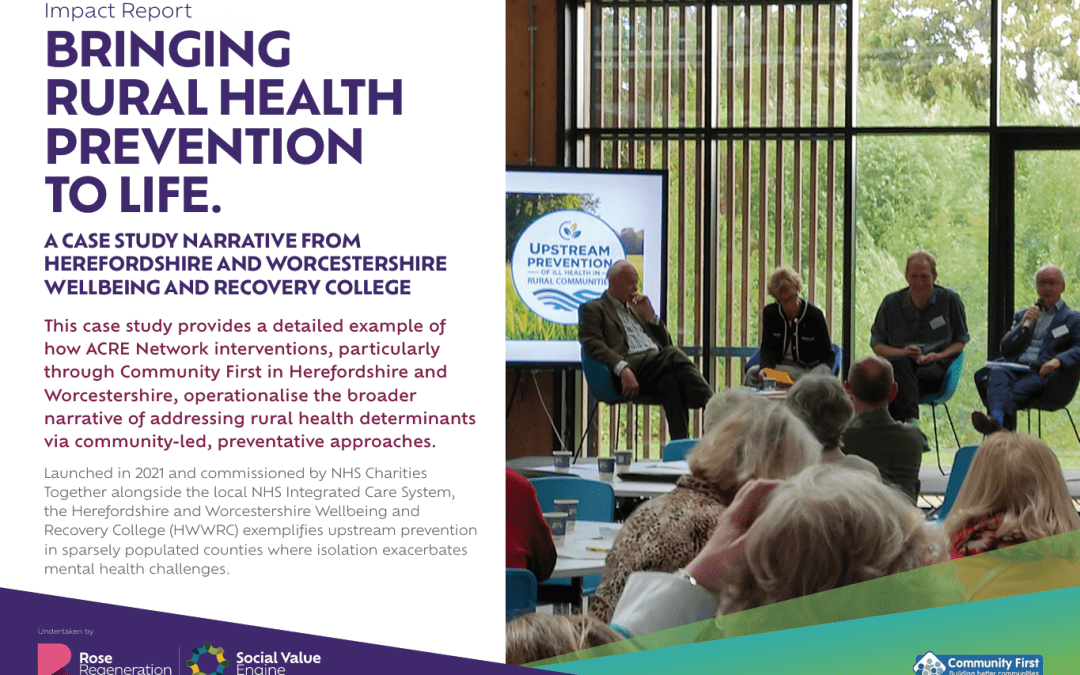
Building on this, Community First’s pilot, ‘UP Your Health’—an initiative derived from Upstream Prevention (2025–2026), supported through a package of third-party funding, extends the model. Targeting village halls as community health hubs, it involves cluster meetings, door-to door surveys, and open days to train 200 residents and volunteers in preventative behaviours. Activities emphasise movement, diet, social connection, and early intervention, addressing loneliness (as harmful as smoking), obesity, and inactivity. Future aspirations include national scaling through ACRE, with expert input from figures like Sir Michael Marmot on social determinants of health, and evidence partnerships with The University of Worcester.
This initiative illustrates rural-proofing in action: empowering isolated elderly and disabled individuals through local, trusted venues, preventing ill health upstream, and yielding measurable savings. By embedding prevention in everyday community life, HWWRC not only alleviates immediate pressures but fosters resilient, connected rural societies—proving that targeted, evidence-based efforts can transform health inequalities into sustainable wellbeing.