
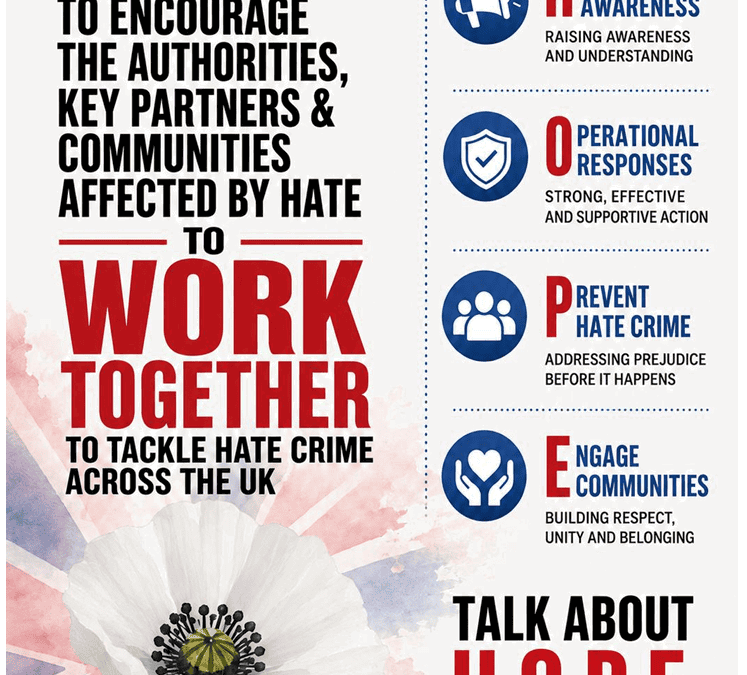
Saturday 10th October sees World Mental Health Day https://wmhdofficial.com/ and the start of Hate Crime Awareness Week https://nationalhcaw.uk/
The theme for World Mental Health Day is “Lived experiences heard: real voices, real change” (set by the World Federation for Mental Health). Listening to and learning from individuals with lived experience of mental health conditions to shape policies, workplace practices, and support services.
People with mental health conditions are at increased risk of disability-related hate crime AND Individuals who experience hate crime often suffer increased stigma, fear, anxiety, loss of confidence and long-term psychological distress, which can lead to and worsen existing mental health problems.
This overlap highlights the fact that hate crime can have a significant impact on both stigma and mental health, affecting not only the individual victim but also the wider community that shares the targeted identity.
Stigma occurs when people are negatively judged, stereotyped, or discriminated against because of a characteristic such as a mental health condition, but it can also be because of any personal characteristic. In England and Wales, the personal characteristic most commonly targeted in recorded hate crimes is race or ethnicity. According to the Home Office, race hate crime consistently accounts for the majority of hate crimes reported to police.
Hate crime is a criminal act motivated by hostility, prejudice, or bias towards a person’s identity or perceived identity.
Three ways you can help prevent hate crime and promote positive mental health:
- challenge prejudice and stereotypes (become an Active Bystander) https://www.worcester.ac.uk/about/academic-schools/school-of-health-and-wellbeing/health-and-wellbeing-research/bystander-intervention-programme/
- report hate incidents to the police or support organisations (call 101 or 999)
- promote inclusion and respect within communities (learn more about mental health https://mhfaengland.org)